
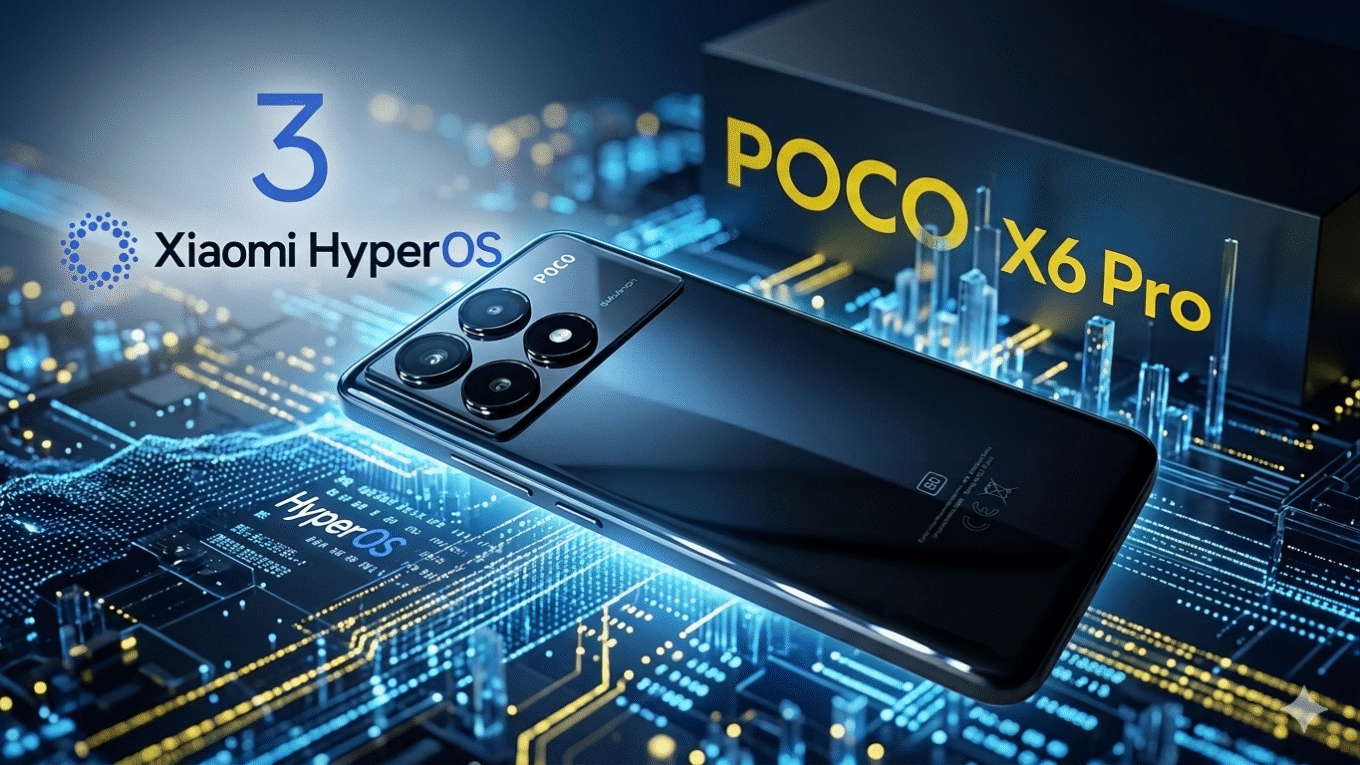
Poco X6 Pro HyperOS 3 Is Here: Official ROMs, All Regions Status & Public Rollout Before March 31st
The wait is over — and the public release may arrive before March 31st. The Poco X6 Pro officially received its first HyperOS 3 builds on March 27, 2026, landing simultaneously in the India and Mi Global regions with Android 16 at the core. Three days later, on March 30, the Poco X6 5G moved from Mi Pilot to Open to the Public in India — a clear signal that the Poco X6 Pro is next in line, and the transition could happen before the end of the month.
The HyperOS 3 update for the Poco X6 Pro is not a routine maintenance release. It carries a complete jump from Android 15 to Android 16, a full visual redesign, a rebuilt notification system, post-quantum encryption for data protection, and a 5.8 GB installation package that reflects just how deep the changes run. This guide consolidates everything: official build details, regional rollout status, the complete changelog, the three update phases explained, and exactly what to do depending on where you stand right now.
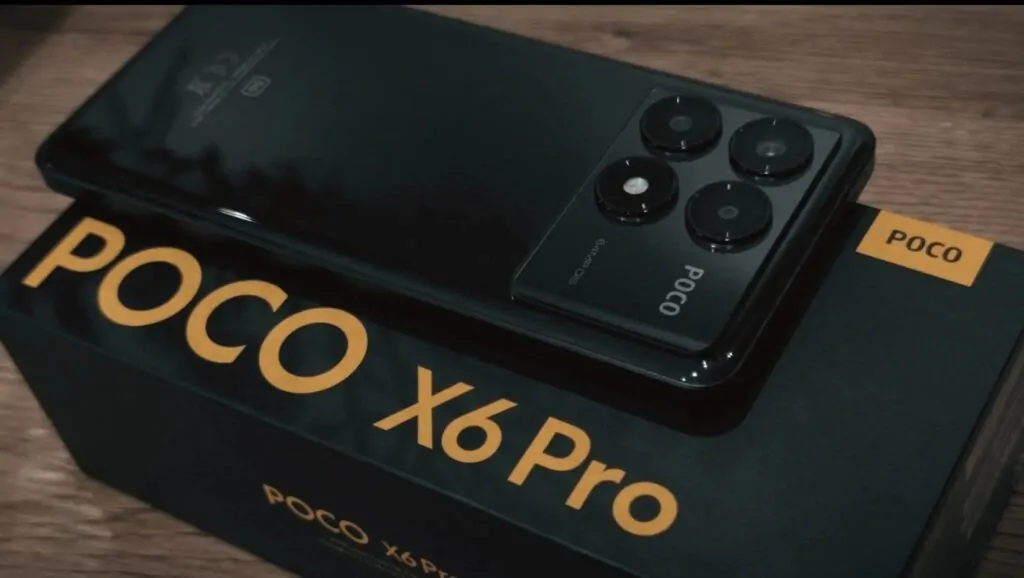
Official HyperOS 3 Builds Confirmed — Poco X6 Pro | March 27, 2026
India 🇮🇳
- ROM: OS3.0.3.0.WNLINXM
- Android: 16
- Status: Mi Pilot Release
- Release date: March 27, 2026
- Package size: 5.8 GB
- Codename: Duchamp
- Security patch: February 2026
Mi Global (Global Standard Region)
- ROM: OS3.0.4.0.WNLMIXM
- Android: 16
- Status: Mi Pilot Release
- Release date: March 27, 2026
- Package size: 5.8 GB
- Codename: Duchamp
- Security patch: February 2026
Complete Regional Status Table — Poco X6 Pro (Duchamp) | HyperOS 3
| Region | ROM | Android | Status | Date | Package | Patch |
|---|---|---|---|---|---|---|
| India 🇮🇳 | OS3.0.3.0.WNLINXM | 16 | Mi Pilot | 27/03/2026 | 5.8 GB | Feb/2026 |
| Mi Global 🌍 | OS3.0.4.0.WNLMIXM | 16 | Mi Pilot | 27/03/2026 | 5.8 GB | Feb/2026 |
| Europe (EEA) 🇪🇺 | OS3.0.4.0.WNLEUXM | 16 | Awaiting correction | — | — | Awaiting Feb/2026 |
| Indonesia 🇮🇩 | OS3.0.2.1.WNLIDXM | 16 | Internal testing detected | — | — | — |
| Russia 🇷🇺 | OS3.0.2.1.WNLRUXM | 16 | Internal testing detected | — | — | — |
| Taiwan 🇹🇼 | OS3.0.2.1.WNLTWXM | 16 | Internal testing detected | — | — | — |
Total active regions: 3 (India, Mi Global, Europe) Next regions: Indonesia, Russia, and Taiwan — internal testing detected as of March 28, 2026 Europe note: ROM OS3.0.4.0.WNLEUXM is active but awaiting a corrective update to align with the February 2026 security patch level before advancing to the next status Regional pattern insight: Mi Global and India historically lead Mi Pilot build distribution for POCO devices. Indonesia, Russia, and Taiwan typically follow within 3 to 7 days. Europe moves at a slightly different pace depending on compliance requirements.
What “Moving to Public Release Before March 31st” Actually Means
On March 30, 2026, the Poco X6 5G (Redmi Note 13 Pro 5G) moved from Mi Pilot to Open to the Public in India — the same device family, same platform generation. That transition is a direct signal for Poco X6 Pro users: the Mi Global and India builds are expected to exit Mi Pilot and enter the Public release phase before the end of March.
As of 7:15 AM on March 30, updates for multiple devices started rolling out simultaneously. The Poco X7 Pro received its Mi Global build 0.10.0 with the March 2026 security patch open to the public. The Xiaomi Pad 7 Pro CN region received HyperOS 3.1 open to the public. The pattern is consistent: when builds start moving to public status in volume, the queue moves fast.
The prediction stands: Poco X6 Pro Mi Pilot builds for India and Mi Global are expected to advance to partial or fully open rollout before midnight on March 31st. A follow-up video will confirm the moment it happens.
The Three HyperOS Update Phases — What They Mean for the Poco X6 Pro
Not receiving the update yet does not mean anything is wrong with your device. The HyperOS 3 distribution for the Poco X6 Pro follows a structured three-phase process that every Xiaomi, POCO, and Redmi device goes through before reaching all users.
Phase 1 — Mi Pilot (Closed Beta)
The first public phase is Mi Pilot, also called Mi Palette in some system versions. During this phase, the build is available exclusively to users enrolled in Xiaomi’s official beta testing program. Enrolled users can either wait for the automatic notification or manually force the download through the three-dot menu in the system update screen.
One important nuance: even users who are not enrolled in Mi Pilot sometimes receive the update during this phase — particularly those who have changed their device region or have specific account configurations. This is not a system error; it’s a server-side behavior that occasionally releases to a broader group than expected.
Phase 2 — Partial Rollout
When the build advances from Mi Pilot to Partial, Xiaomi begins distributing it via OTA to a growing percentage of users — typically starting at 1% to 5% of the eligible base, expanding over subsequent days as stability is confirmed. During this phase, receiving the notification without being enrolled in Mi Pilot is possible but not guaranteed.
Phase 3 — Open to the Public
The final phase is when the update becomes fully open — the server releases it to 100% of eligible devices in that region simultaneously. From that point, every device owner in the correct region receives the automatic OTA notification without needing to do anything manually.
Practical takeaway: If your Poco X6 Pro is in a region where the build is in Mi Pilot and you haven’t received it, that is the normal process working correctly. You can wait for the rollout to advance, or you can force the update manually right now.
Complete HyperOS 3 Changelog — Poco X6 Pro (Duchamp)
The 5.8 GB package size is not padding — it reflects a complete architectural transition from Android 15 to Android 16. Here is every confirmed change.
Performance and Efficiency
Compiler instructions were refined at the code level, producing measurable improvements in system responsiveness while reducing power consumption. The memory allocation and recovery system was rebuilt to make more RAM available to active applications at any given moment. Integrated frequency scheduling was optimized to balance peak performance demands against battery draw more precisely. Short-video playback efficiency received dedicated improvements specifically to extend battery life during that type of use.
Graphics and Animations
A new window rendering mechanism reduces the load placed on the GPU during routine system operations — the direct result is less heat generation during everyday use and smoother visual transitions throughout the interface. More than 100 system animation scenes were individually reviewed and re-tuned for more natural, fluid motion.
Xiaomi HyperIsland — Rebuilt Notification Experience
The HyperIsland notification area received one of the most significant overhauls in this build. The new format merges the Notification Spotlight with standard device notifications into a single unified space, ensuring that critical information reaches users faster. The redesigned UI displays more detail at a glance, with smoother state transitions between different island configurations. Users can now pull down to expand smaller windows, enabling faster task switching without leaving the current context.
Visual Redesign — System-Wide
Home screen icons were redesigned with finer detail and sharper resolution. The home screen grid received rebalanced margins and improved spacing for a more comfortable layout. The status bar was streamlined with a cleaner, more legible layout. A new design system unifies color treatment, standardizes rounded corners across the entire operating system, and makes controls more intuitive to use. The lock screen introduces a large-clock format with deeper visual layering. A new unified wallpaper editor allows simultaneous adjustment of both the home screen and lock screen backgrounds in a single session.
System App Optimizations
Gallery: New widgets allow users to select preferred collections for display. Albums can now be pinned for instant access at any time. Weather: Content card blur effects were refined for smoother scrolling immersion. Calendar: A week view was added. The month view received visual updates with clearer holiday and important event highlighting. Recorder: Start page categories were reorganized using icons for faster content location. Playback quality was improved with intelligent noise reduction for clearer voice recordings.
Privacy and Security
The privacy and password interface was redesigned with a cleaner, more modern layout. Advanced data protection now leverages post-quantum encryption — one of the most advanced security implementations Xiaomi has deployed in any consumer device. This protects personal data against future cryptographic threats, not just current ones.
Why the Poco X6 Pro Took Longer Than Other Devices
The question circulating in the community for weeks — why the Poco X6 Pro lagged behind the Poco X6 5G and Poco X7 despite being from the same product generation — has a two-part answer that’s now fully documented.
The first factor is community feedback volume. The Poco X6 5G (Redmi Note 13 Pro 5G) had a significantly more organized user base in terms of submitting structured reports through Xiaomi’s official Feedback app. That volume of consistent, specific reports accelerated the development team’s validation cycle. The second factor is Xiaomi’s internal team assignment structure — different device models are handled by different development groups, and those groups don’t always operate on the same timeline.
The turning point came when the TECnoVAs Solution channel — recognized by Xiaomi’s Mi Community as an official representative voice for the Brazilian market — formally documented and submitted all reported issues after a one-hour direct session with a Xiaomi community moderator. Three days after that submission, the first Mi Pilot build appeared for India. The organized pressure worked exactly the way it had worked for the Poco X6 5G weeks earlier. For the full documented history of that process, the official bug reports, and the internal testing detection timeline, the Portuguese-language reference is O Poco X6 Pro Finalmente Recebe o HyperOS 3 de Forma Oficial.
What to Do Right Now — Based on Your Situation
You Are Enrolled in Mi Pilot
Go to Settings > About Phone. Tap the HyperOS logo repeatedly until you see the “enabled” notification. Tap the three-dot menu in the upper right corner. Select download full update package. Ensure you are on a stable Wi-Fi connection before initiating the 5.8 GB download. After installation, allow several hours for the system to complete background optimization before evaluating performance.
You Are Not Enrolled in Mi Pilot
The public rollout has not yet been initiated for all regions, but is expected before March 31st. If you want to receive it without enrolling in Mi Pilot, one documented method is changing your device region — certain server regions operate with open rollout status rather than Mi Pilot gates. By switching to regions like Morocco or others with open servers, the OTA can arrive automatically. There is no official published list of which regions have open servers at any given moment, so the process involves testing different regions throughout the day. If you prefer to wait, the public release should reach your device automatically once the rollout phase advances.
You Are Experiencing Bugs After Updating
For a build of this scale — a full Android version transition — some instability in the first days is expected. The correct procedure before any factory reset is to download and install the full ROM package of your current version through the three-dot menu in the update screen. This replaces all system files cleanly without erasing any personal data, apps, or settings. The step-by-step tutorial for this process is covered in the guide Poco X6 Pro: Not Receiving HyperOS 3? Understand the 3 Phases and What to Do.
The Unlocked Bootloader Warning — Read This Before Assuming Your Device Is Broken
There is one specific scenario where a Poco X6 Pro — or any Xiaomi device — will never receive an OTA update regardless of how many times you check manually: an unlocked bootloader.
To check: restart your device and observe the boot screen. If you see an open padlock icon, your bootloader is unlocked. This means a non-official ROM was installed at some point — often before the device was even sold, particularly on units purchased through third-party marketplaces. Xiaomi’s update servers automatically reject OTA delivery to devices in this state.
The fix exists: install the official ROM for your device’s correct region manually. Once completed, the device returns to normal OTA eligibility. If you need guidance on identifying your device region and installing the correct ROM manually, the full process is documented at How to Force HyperOS 3 on Any Xiaomi Device.
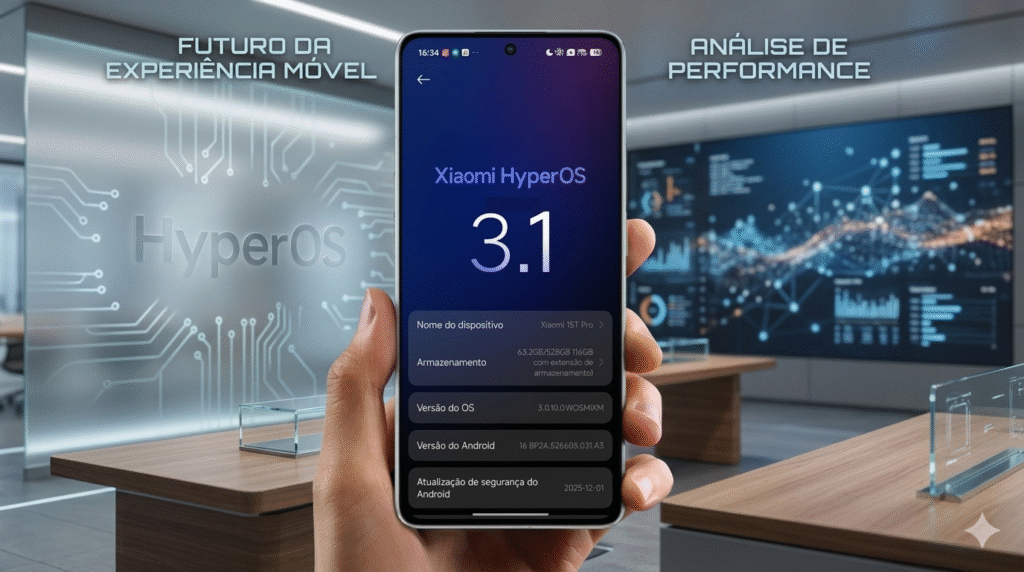
What Else Changed in the HyperOS 3 Ecosystem This Week
While the Poco X6 Pro transition is the headline, March 30 brought a broader wave of updates that gives important context. The Poco F8 Ultra received builds in Mi Global (OS3.0.13.0), Europe (OS3.0.8.0), and Taiwan (OS3.0.6.0), all open to the public. The Xiaomi Pad 7 Pro in the CN region received HyperOS 3.1 open to the public — confirming that the 3.1 cycle is now in active public distribution for premium hardware. The Redmi 14C / Poco C75 received its first fully public HyperOS 3 build in Indonesia with an extensive changelog. The Xiaomi 13T appeared in the Mi Global preparation queue — its first Mi Pilot build is expected shortly.
The POCO Launcher has also been active in this cycle. A recent update introduced iOS-style recents navigation to HyperOS 3, giving users a familiar card-based task switching interface that many had been requesting since the transition from MIUI. Details on that update are covered at Poco Launcher Update Brings iOS-Style Recents to HyperOS 3.
What Comes After HyperOS 3 — The Road to Android 17
With HyperOS 3 now in active rollout for the Poco X6 Pro, the longer-term picture is worth noting. Xiaomi has officially confirmed that the device is on the list to receive Android 17 via HyperOS 4 — guaranteeing at least one more major OS cycle ahead. That places the Poco X6 Pro in a comfortable position for software longevity, relevant both for current owners and anyone evaluating a purchase. The complete confirmed device list for Android 17 is detailed at Android 17 Officially Coming to Over 70 Xiaomi Devices.
Complete Key Facts List — Poco X6 Pro and HyperOS 3
- Poco X6 Pro officially received HyperOS 3 on March 27, 2026
- India: ROM OS3.0.3.0.WNLINXM | Android 16 | Mi Pilot | 5.8 GB | Security patch Feb/2026
- Mi Global: ROM OS3.0.4.0.WNLMIXM | Android 16 | Mi Pilot | 5.8 GB | Security patch Feb/2026
- Europe: ROM OS3.0.4.0.WNLEUXM active — awaiting corrective update with February 2026 patch
- Indonesia: ROM OS3.0.2.1.WNLIDXM — internal testing detected March 28, 2026
- Russia: ROM OS3.0.2.1.WNLRUXM — internal testing detected March 28, 2026
- Taiwan: ROM OS3.0.2.1.WNLTWXM — internal testing detected March 28, 2026
- Total active regions: 3 (India, Mi Global, Europe)
- Device codename: Duchamp
- 5.8 GB package reflects complete Android 15 → Android 16 system transition
- On March 30, Poco X6 5G moved to Open to the Public in India — X6 Pro expected next
- Public release for India and Mi Global expected before March 31, 2026
- Changelog includes: compiler-level performance, new rendering engine, HyperIsland rebuild, full visual redesign, post-quantum encryption
- Over 100 animation scenes individually retuned
- Mi Pilot enrolled users can force install now via three-dot menu
- Not receiving OTA is not a device defect — it reflects the current phase of the rollout
- Open padlock on boot screen = unlocked bootloader = OTA will never arrive until official ROM is reinstalled
- Poco X6 Pro confirmed for Android 17 via HyperOS 4
- Mi Global and India lead Mi Pilot distribution; Indonesia, Russia, Taiwan follow within 3–7 days
Conclusion
The Poco X6 Pro HyperOS 3 story has moved from months of waiting to a rapidly unfolding public release. The Mi Pilot builds are live in India and Mi Global. Indonesia, Russia, and Taiwan have ROM strings in internal testing. Europe is awaiting a corrective patch. And based on the pace of March 30 — with multiple devices crossing from Mi Pilot to Open to the Public simultaneously — the full public rollout for the Poco X6 Pro is expected before the end of March.
If you’re enrolled in Mi Pilot, update now. If you’re not, the public notification is days away at most. If your device shows an open padlock on boot, the OTA issue has nothing to do with the rollout — it’s a bootloader state that needs a manual ROM fix first.
For real-time tracking of every new build as it lands — by device, region, and status — follow the HyperOS 3 Global Update Tracker and the TECnoVAs Telegram channel.
FAQ — Poco X6 Pro HyperOS 3: The Most Searched Questions
1. Has the Poco X6 Pro officially received HyperOS 3? Yes. India received OS3.0.3.0 and Mi Global received OS3.0.4.0 on March 27, 2026. Both in Mi Pilot with Android 16.
2. What ROM version is HyperOS 3 for the Poco X6 Pro Mi Global? OS3.0.4.0.WNLMIXM, Android 16, Mi Pilot, released March 27, 2026, 5.8 GB package, Feb/2026 patch.
3. Is HyperOS 3 on the Poco X6 Pro based on Android 15 or 16? Android 16. The Poco X6 Pro jumped directly from HyperOS 2.x on Android 15 to HyperOS 3 on Android 16.
4. How do I force the HyperOS 3 update on the Poco X6 Pro as a Mi Pilot user? Settings > About Phone > tap logo repeatedly > three-dot menu > download full update package. Need stable Wi-Fi.
5. Why haven’t I received the Poco X6 Pro HyperOS 3 update yet? The build is in Mi Pilot phase. Only enrolled beta users receive it automatically. Public rollout expected before March 31.
6. What does the open padlock on boot mean for Poco X6 Pro updates? Unlocked bootloader — non-official ROM installed. OTA updates will never arrive until the official ROM is reinstalled manually.
7. Will the Poco X6 Pro receive Android 17? Yes. Officially confirmed for Android 17 via HyperOS 4 in a future cycle.
8. When will HyperOS 3 be Open to the Public for the Poco X6 Pro? Expected before March 31, 2026 based on current rollout pace and the Poco X6 5G already moving to public on March 30.