
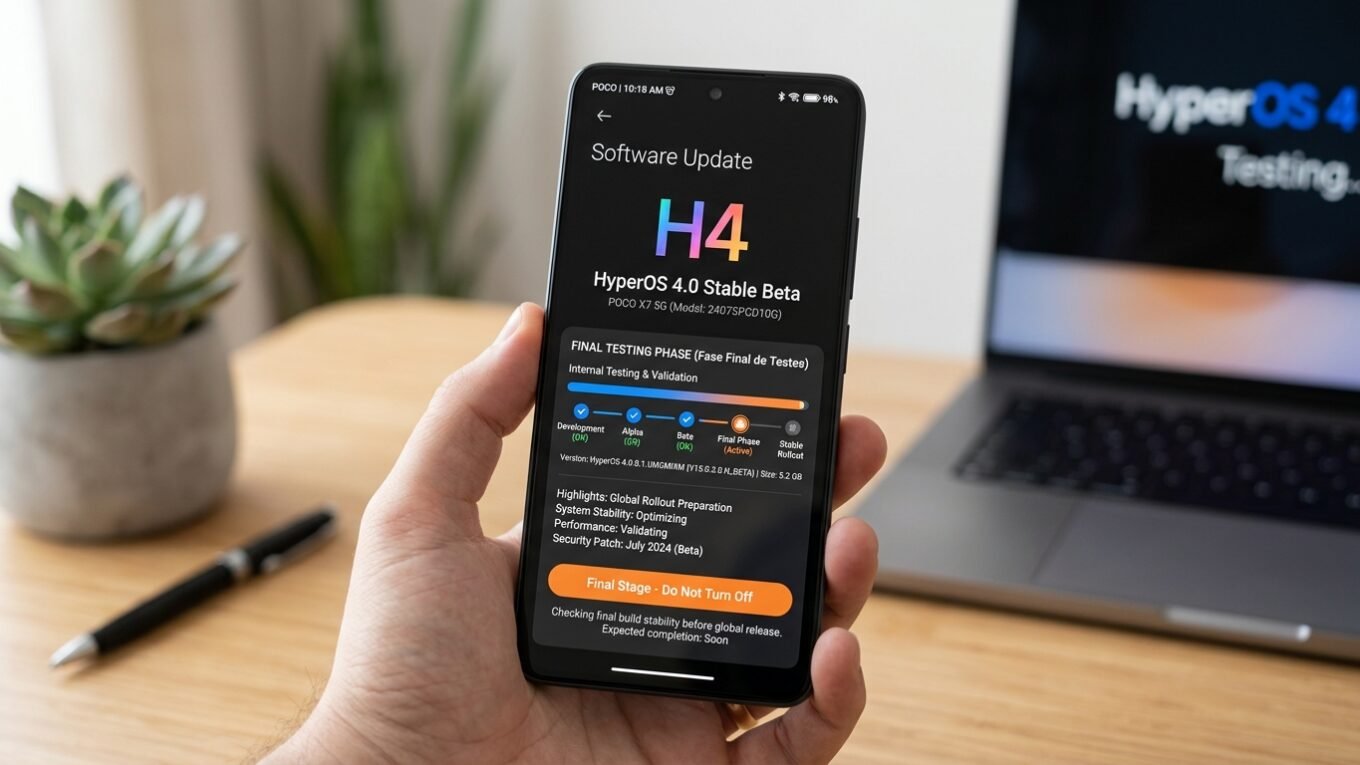
HyperOS 4: Xiaomi, Redmi, and POCO Devices Enter the Final Stage of Internal Testing
What’s happening with HyperOS 4
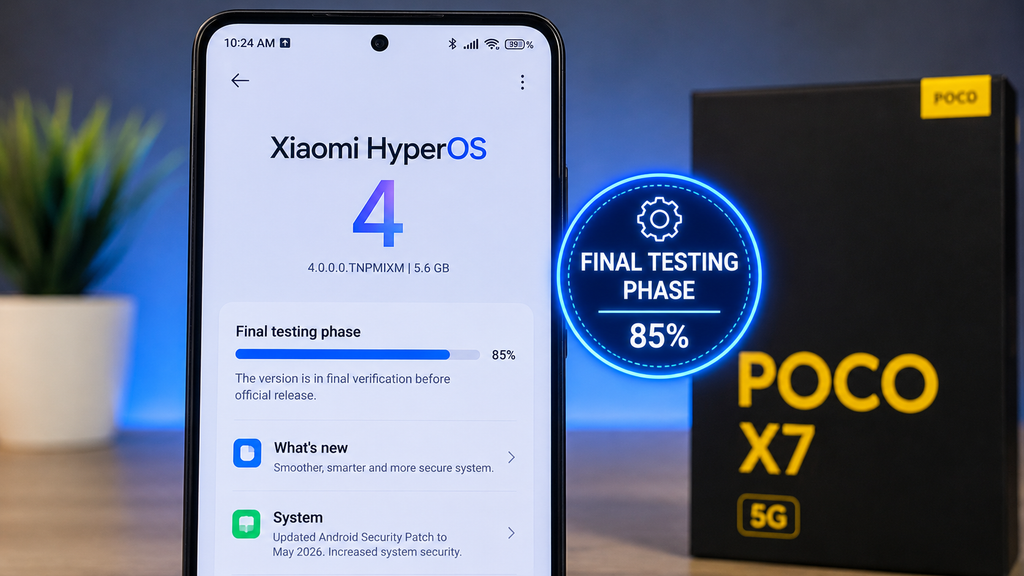
HyperOS 4, Xiaomi’s next major system update based on Android 17, is moving through the final stretch of internal testing. According to the update-tracking channel used as a source for this article, the last day of August 2026 marks the end of internal testing for a large number of Xiaomi, Redmi, and POCO devices, with beta testers expected to start receiving the update as early as the beginning of September.
It’s important to understand what that actually means in practice: “final stage of internal testing” is not the same as “public beta available.” Cross-checking independent sources confirms that Xiaomi has already officially opened the HyperOS 4 beta — but so far only in China, rolled out in batches starting August 13–14, 2026, with a second batch beginning August 27. For global markets (the region identified by the MIXM code, which includes the U.S.), Xiaomi has not yet announced an official beta date. Industry coverage expects the stable global release sometime between September and October 2026, following the same pattern as HyperOS 3, which launched in China in August and went global in September the year before.
In short: the list of devices “in the final stage” reflects internal builds picked up through firmware tracking — a strong signal that launch is close, but not yet confirmation that it’s available to end users.
Why this matters now
If you own a POCO X7, POCO X7 Pro, or Redmi Note 14 Pro 5G — the devices with the highest search interest around this topic — reaching the final stage of internal testing is the clearest sign yet that the update is getting close. The creator of the source video, who tracks these builds daily, makes a prediction: the POCO X7 Pro and POCO X7 are likely to be among the first to get HyperOS 4 once the global beta opens.
How to become a beta tester
According to the source video, you can sign up for Xiaomi’s beta tester program by completing an eligibility questionnaire — you need to score at least 65 points to be accepted and receive updates early. This process happens inside the Xiaomi Community app (also called Mi Pilot in some regions), under the beta testing section.
Worth repeating: this applies to the beta program, which today is open only in China. For the global region, the recommendation is to keep an eye on Xiaomi’s official channels for an announcement about the international beta opening.
Related feature: screen recording with system audio
One detail from the source video worth flagging for content creators, especially gamers: starting with HyperOS 3.1, Xiaomi’s native screen recorder can now capture system audio and microphone audio at the same time. That makes it easier to produce gameplay videos without needing a third-party app to mix the two audio sources.
How to check your device’s region
One of the most useful points from the source video is how to identify which region your firmware belongs to — essential for knowing whether the information in a list like this applies to you.
The system version code is a string of letters and numbers. The first letter indicates the Android version (for example, “W” corresponds to Android 16 in the example cited in the video). The last four letters indicate the region:
- MIXM — standard global region
- EEA or EU — Europe
- RU — Russia
- TW — Taiwan
- Other codes identify specific markets, such as Turkey and China (CN)
To check, go to Settings > About phone > MIUI/HyperOS version on your device and look at the last characters of the code shown.
Devices reported in the final stage of internal testing
The table below consolidates every device mentioned in the source video, organized by model, with the region(s) and status reported by the creator. According to the source, all listed devices are based on Android 17 and HyperOS 4, in the final stage of internal testing — none of them have official confirmation of public availability outside China as of this update.
| Device | Also known as | Reported region(s) | Reported status |
|---|---|---|---|
| POCO M8 5G | Redmi Note 15 5G | Global (MIXM) | Final stage |
| POCO C85 4G | Redmi 15C 4G | Global (MIXM) | Final stage |
| POCO C85 5G | Redmi 15C 5G | Global (MIXM) | Final stage |
| POCO C95 Pro | Redmi 17 4G | Global (MIXM) | Final stage |
| POCO M6 Pro 4G | Redmi Note 13 Pro 4G | Global (MIXM) | Final stage |
| POCO M7 4G | Redmi 15 4G | Global (MIXM) | Final stage |
| POCO M7 Plus | Redmi 15 (same codename) | Global (MIXM) | Final stage |
| POCO M8 Pro 5G | Redmi Note 15 Pro Plus 5G | Global (MIXM) | Final stage |
| POCO M8 Power | Redmi Note 17 5G | Global (MIXM) | Final stage |
| POCO X7 | Redmi Note 14 Pro 5G | Global (MIXM) | Final stage |
| POCO X7 Pro | — | Europe and Global (all regions completed) | Internal testing finished |
| POCO X8 | Redmi Note 17 Pro 5G | Global (MIXM) and China (CN) | Final stage |
| POCO X8 Pro | — | Turkey and Europe | Final stage |
| POCO X8 Pro Max | — | Turkey and Global (MIXM) | Final stage |
| POCO X Pro (POCO X8 Pro variant) | — | Taiwan | Final stage |
| POCO F6 | — | Global (MIXM) | Final stage |
| POCO F7 | — | Global (MIXM) | Final stage |
| POCO F7 Pro | — | Global (MIXM) | Final stage |
| POCO F9 Pro | — | Global (MIXM) | Final stage |
| Xiaomi 13 | — | Global (MIXM) | Final stage |
| Xiaomi 13 Pro | — | Europe and Global (MIXM) | Final stage |
| Xiaomi 13 Ultra | — | Global (MIXM) | Final build |
| Xiaomi 13T | — | Global (MIXM), Europe, and Taiwan | Final stage |
| Xiaomi 14T | — | Global (MIXM) | Final stage |
| Xiaomi 15 | — | Global (MIXM) | Final stage |
| Xiaomi 15T | — | Global (MIXM) | Final testing stage |
| Xiaomi 15T Pro | — | Global (MIXM) — currently on HyperOS 3.3, receiving Android 17 internal tests | Ready for launch (HyperOS 4 build) |
| Xiaomi 15 Ultra | — | Global (MIXM) | Final stage |
| Xiaomi 17 | — | Global (MIXM); already running on Mi Pilot in China | Final internal testing stage |
| Xiaomi 17T | — | Russia | Internal testing finished, ready for launch |
| Xiaomi 17T Pro | — | Global (MIXM) | Final stage |
| Xiaomi Pad 7 Pro | — | Global (MIXM) | Final stage |
| Redmi Note 14 4G | — | Global (MIXM) | Final stage |
| Redmi Note 14 Pro 4G | — | Global (MIXM) | Final stage |
| Redmi Note 14 Pro Plus | — | Global (MIXM) | Final stage |
| Redmi Note 15 Pro | — | Global (MIXM) | Final stage |
| Redmi Note 15 Pro 4G | — | Global (MIXM) | Final stage |
| Redmi Pad 2 4G | — | Europe | Final stage |
Transparency note: the table above reflects exactly what was reported in the source video (published by an update-tracking channel), except for one ambiguously named item in the original material (“Redmi 2 4G,” Europe region), which we left out of the table because it isn’t clear which device is actually being referenced. Nothing here has been supplemented, guessed, or independently verified against Xiaomi’s official builds beyond what the source reports — so treat the “final stage” statuses as third-party reporting (in testing / not officially confirmed by Xiaomi), not an official statement from the manufacturer.
Fact, analysis, and expectation
FACT: Xiaomi has already officially launched the HyperOS 4 public beta in China, in batches, since mid-August 2026.
ANALYSIS: The large number of internal builds identified for the global (MIXM) region, including popular models like the POCO X7 and Redmi Note 14 Pro 5G, is a consistent signal that the international beta is in advanced preparation.
EXPECTATION: The “early September” date for the global beta, mentioned in the source video, still has no official confirmation from Xiaomi. Independent sources point to a wider window, between September and October 2026, for the global launch — which doesn’t invalidate the expectation, but reinforces that it should be treated as an estimate, not a confirmed date.
What to do now
If your device is on the list above, there’s no action needed right now beyond keeping an eye on Xiaomi Community’s official channels for the global beta announcement. Once sign-ups for international beta testers open, the process runs through the eligibility questionnaire inside the app, with a minimum score required to participate.
One thought on “HyperOS 4: Xiaomi, Redmi, and POCO Devices Enter the Final Stage of Internal Testing”