

HyperOS 4 Global Beta Program Kicks Off With First Devices
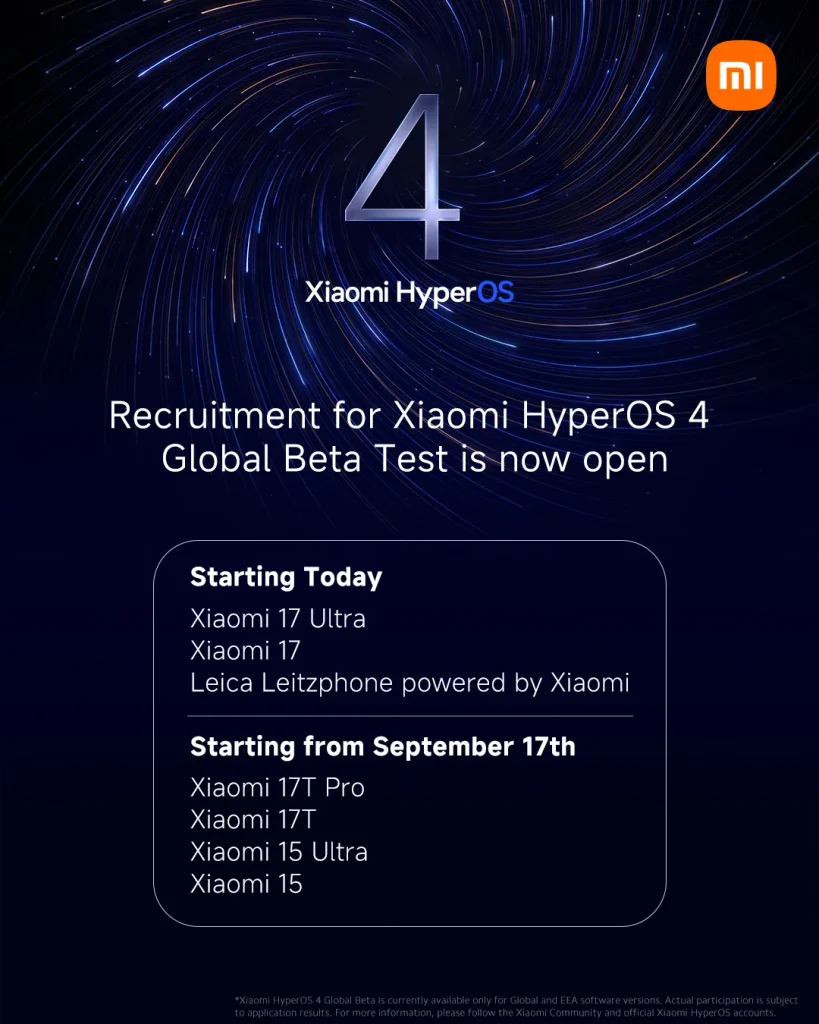
Xiaomi has officially opened recruitment for the HyperOS 4 global beta program, giving the first wave of eligible users a chance to try the company’s next system update before its public release. The rollout is limited to Global and European Economic Area (EEA) firmware variants, and it isn’t going out to every supported phone at once — Xiaomi is staggering access across separate device groups.
CONFIRMED: Recruitment for the HyperOS 4 beta has begun for the first group of devices.
Which phones are in the first beta group
The initial recruitment phase covers three devices:
- Xiaomi 17 Ultra
- Leica Leitz Phone powered by Xiaomi
- Xiaomi 17
Anyone with one of these phones on an eligible Global or EEA build can apply through the Xiaomi Community app, under EU → Beta Test → Recruitment Test. The process requires filling out a short questionnaire, after which applicants can check their approval status on the same page.
Xiaomi has been clear that this is a preliminary build rather than a finished release: the company has not committed to a fixed public rollout schedule for HyperOS 4, so approved testers should treat the timeline as open-ended for now.
A second group joins on September 17
CONFIRMED: A second recruitment wave opens on September 17.
Xiaomi confirmed that a second batch of eligible devices will open its own recruitment window on September 17:
- Xiaomi 17T Pro
- Xiaomi 17T
- Xiaomi 15 Ultra
- Xiaomi 15
This staged approach mirrors how Xiaomi has handled previous HyperOS betas — rather than flipping a single switch for the whole lineup, the company is opening the door model by model, likely to manage feedback volume and catch device-specific bugs before scaling up. Readers tracking every supported phone can follow the full rollout timeline in TECnoVas’s HyperOS 4 final testing devices list, which tracks which models have already entered internal testing ahead of a public beta.
Stability warnings and the downgrade catch
BETA/TESTING: Xiaomi is warning testers upfront that this build carries real risk.
Xiaomi’s own guidance flags that the HyperOS 4 beta may be less stable than a finished release and could cause compatibility issues with some third-party apps. The company recommends backing up important data before installing, and suggests that participants have at least basic familiarity with firmware updates and troubleshooting — this isn’t positioned as a beginner-friendly install.
The bigger catch is the downgrade path. HyperOS 4 Beta cannot be reverted to HyperOS 3 through a normal OTA update. According to Xiaomi, anyone who wants to roll back needs to go through a full system reinstallation (flashing), and the company recommends having that done at an authorized service center rather than attempting it independently. Data may be erased during the process, so this isn’t a decision to make lightly on a primary phone.
Because of that risk, Xiaomi’s advice is straightforward: if your phone is essential for work or daily tasks, install the beta on a secondary device instead. Some apps may still need adaptation for HyperOS 4 and could behave unpredictably or lose functionality until developers catch up.
What’s new in HyperOS 4’s design
Material shared alongside the announcement outlines several interface changes planned for the release. Xiaomi is calling the new visual language “Soft Light Glass,” built around translucent, layered elements that show up across the interface. The lock screen has been redesigned, and notifications can now be grouped together instead of appearing as a long, flat list.
On the home screen, widgets can now be stacked, and folder placement is described as more flexible than before. Xiaomi is also rolling out a redesigned Fusion Device Center, which brings phones, tablets, watches, computers, and smart home products into a single control area — a continuation of the cross-device push HyperOS has leaned on since launch.
BETA/TESTING: These design elements come from material tied to the beta announcement and reflect what’s currently planned, which can still shift before a stable release.
For context on the broader Android platform HyperOS builds on top of, Google has detailed what’s changing at the OS level in its own rundown of Android 17 features, and Xiaomi maintains its official reference for the software on the HyperOS site.
What changed under the hood
Xiaomi also published a changelog alongside this beta cycle, covering fixes and optimizations across several system components:
- Super XiaoAI: Fixed abnormal keyboard calls in certain scenarios.
- System: Fixed abnormal game memory usage display, keyboard display issues in recent tasks, fingerprint unlock lag, occasional silent audio during video playback and scrolling, and abnormal display of desktop icons and recent tasks.
- Desktop: Optimized UI display for certain large icons and widgets; fixed abnormal icon display in certain themes and abnormal gesture navigation.
- Gallery: Optimized responsiveness; fixed abnormal display of the gallery widget.
- Weather: Optimized rainy-weather animations and bottom-button visual effects; improved settings page smoothness and app stability; fixed an abnormal menu button animation on the city management page.
- Calendar: Optimized daily view when switching between portrait and landscape; fixed screen flickering between weekly and daily views, and abnormal display of schedule management in pop-up window mode.
- Global Search: Fixed an abnormal display issue on the search page.
INTERNAL TESTING: These changelog entries reflect fixes tied to the current beta build and describe incremental refinements rather than headline features.
6. Quick Answer
Xiaomi has opened HyperOS 4 global beta recruitment, starting with the Xiaomi 17 Ultra, Leica Leitz Phone powered by Xiaomi, and Xiaomi 17 on eligible Global/EEA units. A second group — Xiaomi 17T Pro, 17T, 15 Ultra, and 15 — opens applications on September 17. There’s no fixed public release date yet, and downgrading requires a full reinstall rather than a simple OTA.
7. Update Information
| Field | Details |
|---|---|
| Device(s) | Xiaomi 17 Ultra, Leica Leitz Phone (powered by Xiaomi), Xiaomi 17 — second wave: Xiaomi 17T Pro, Xiaomi 17T, Xiaomi 15 Ultra, Xiaomi 15 |
| System | HyperOS 4 (Beta) |
| Version/Build | Not disclosed in official materials |
| Android base | Not specified by Xiaomi in this announcement |
| Region | Global and EEA (European Economic Area) eligible units only |
| Security patch | Not disclosed |
| Size | Not disclosed |
| Status | Beta recruitment open (Group 1); Group 2 opens September 17 |
| Downgrade | Not supported via OTA — requires full reinstall at authorized service |
8. Quick Summary
- Main news: Xiaomi opened HyperOS 4 global beta recruitment
- Devices affected: Xiaomi 17 Ultra, Leica Leitz Phone, Xiaomi 17 (Group 1); Xiaomi 17T Pro, 17T, 15 Ultra, 15 (Group 2)
- Version: HyperOS 4 Beta
- Region: Global / EEA
- Status: Beta recruitment
- Next step: Group 2 recruitment opens September 17; no confirmed public release date yet
9. FAQ
How do I join the HyperOS 4 global beta? Open the Xiaomi Community app and navigate to EU → Beta Test → Recruitment Test, then complete the questionnaire. You can check whether your application was approved on the same page.
Which phones can join the first HyperOS 4 beta group? The first group includes the Xiaomi 17 Ultra, the Leica Leitz Phone powered by Xiaomi, and the Xiaomi 17, limited to eligible Global and EEA units.
When does the second HyperOS 4 beta group open? Recruitment for the second group — Xiaomi 17T Pro, Xiaomi 17T, Xiaomi 15 Ultra, and Xiaomi 15 — opens on September 17.
Can I go back to HyperOS 3 after installing the beta? Not through a normal OTA update. Rolling back requires a full system reinstall (flashing), which Xiaomi recommends handling at an authorized service center, and it may erase your data.
Is the HyperOS 4 beta stable enough for daily use? Xiaomi warns it may be less stable than the finished release and could cause issues with some third-party apps, so the company suggests installing it on a secondary device rather than your main phone.
When will HyperOS 4 launch publicly? Xiaomi hasn’t committed to a fixed release date. The beta is described as a preliminary version without a set launch timeline.
What’s new visually in HyperOS 4? Xiaomi is introducing a “Soft Light Glass” design language with translucent, layered visuals, a redesigned lock screen, grouped notifications, stackable home screen widgets, more flexible folder placement, and a redesigned Fusion Device Center.
Do I need technical experience to install the beta? Xiaomi recommends that participants have basic knowledge of firmware updates and troubleshooting before joining.